Showing posts with label bean. Show all posts

Wednesday, October 14, 2015

Final step for a cup of Coffee, Brewing.

Today we are going to talk about Brewing, which is considered as the weakest link in the enjoyment of a good cup of coffee! You can buy the finest beans, can have the best of the best roast but if you mess up at this step then all the effort putted in are wasted.
The most important thing to understand the brewing method is to understand what goes on in the process. The main components are water and temperature. You need to understand how in brewing the grinded coffee is infused with boiling water to get the flavor out of the powdered coffee.
The best brew is obtained by measuring the Coffee to Water Ratio. The best way to measure coffee is by weight, which is generally done by the scale. It can be measured by volume but it disturbs the coffee taste as it’s not accurate all the time.  It is always wise to brew your coffee strong as it’s easy to divide it to desired taste by adding water.
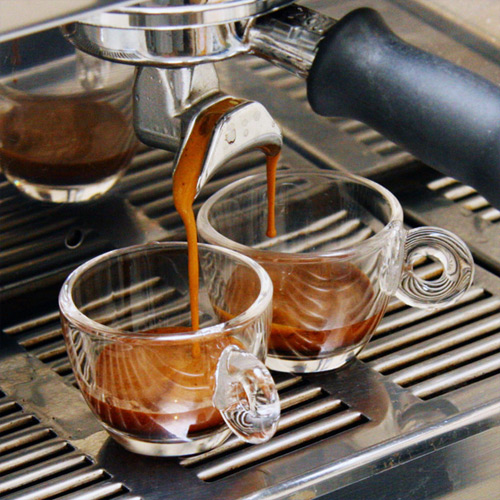
Espresso Shots

The water that is used for infusion has to be right otherwise the coffee will taste wrong. The best rule is to taste the water before using it in brewing as the taste of water changes the taste of coffee.

We are lucky that we don’t have to do all this on our own as the coffee machines does this for us. But the scientists spend a lot of time to attain the determined taste and ratio for every coffee. Various big companies like Starbucks and Tim Horton’s have their own lab to get their right taste for all types of coffee they carry. For instance, a regular double double will be always prepared with the same type of ratio that was discovered in their lab by the machines they have in the restaurants.

Grinding coffee

Today we are going to talk about the final and most important step in the process of coffee making, Grinding Process. Grinding process is important as it determines how the coffee will taste. 
After the roasting process, described in our last post, now we will explain the process of grinding the aromatic coffee beans to attain your favorite tasting coffee.
As by the name grinding seems like an easy process, but there are different types of grinds for different type of coffee. The main objective of grinding is to get most of the flavor out of the beans into the beverage. For example, if you want to make an American coffee the grinding will be coarser (thicker grind); for an espresso (Italian coffee) there will be finer (thinner grind) grinding.
Furthermore, the period of time the grounds (grinded coffee beans) remain in contact with the water determines the ideal grade of grind. The finer the grind is the quicker the coffee is prepared.
It had been scientifically proven that the coffee should be freshly grinded and immediately brewed to get most flavor. These are few examples of how you can distinguish the type of coffee grinder


  • Coarse- this type of grind produces chunky particles of coffee. This type of grind a product of French press coffee machine and most of the cold beverages too.
  • Medium- this is quite similar to coarse but thinner in nature. This is product for machines with drip makers the machines with cone shaped filters.
  • Fine- this type of grind looks more like sugar or salt. Product for espresso machines.
  • Turkish Grind- this one leaves coffee with very powdery grind.

Fun Fact: Coffee is described as a drug due to its caffeine content, which makes it highly addictive and provides a coffee high!! 

Wednesday, October 7, 2015

Different types of Coffee Roasts.

As we mentioned in the last post that there are different types of roasted beans. The degree to which beans are roasted plays a vital role in how it would taste. Basically there are four types of roasted beans which are categorized on the basis of temperature they are roasted on. Coffee from different countries will never taste the same even if it is roasted on same temperature. That’s the beauty of coffee.
Different types of roasts are:
  • Light
  • Medium
  • Medium-Dark
  • Dark
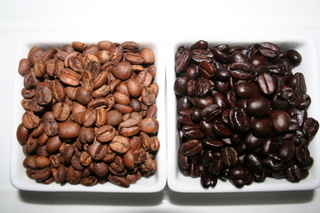
Medium and Dark Roast coffee.


There is no such thing as perfect roast! It is a personal choice according to which taste you like. It is a general misconception that darker the roast the more is caffeine content in it. Whereas the lighter roast has more caffeine because the beans stay for less time in the roaster and the longer they stay in the roaster the more likely they will lose the caffeine content.
Different roasts results in different tastes and producers have named their roasts differently but to name a few common ones:

  • Light roast
            Common roasts are Cinnamon, American, Half City, and Moderate-Light Roast.
            These are Dry in nature.
            Have higher acidity and no roast flavor as it stays for very little time in the roaster.
            Highest content of caffeine.

  • Medium roast
            Common roasts are City and Full City.
            These are also Dry in nature.
            Has no acidity.
            Roast level is attained to a fewer bit.

  • Dark Roast
            Common roasts are Italian, Viennese, and French.
            The bean gets more oily and shiny in nature.
            The aroma and flavour of coffee is clearly evident.
     

  Fun Fact: It takes approximately 42 coffee beans to make an average serving of espresso!!

Green beans to Aromatic Brown Beans.

Welcome back coffee people, this week we will shed some knowledge on Roasting and some different types of roast beans.
Last week we left you by explaining how the cherry fruit is evolved into green beans, we will follow that up as those green beans become some aromatic brown beans. Roasting transforms the green beans into the real brown coffee beans which is the final product that we buy every day.
Roasting is one of the most important step in the coffee making process as it gives the coffee its aroma and flavor, that’s what we enjoy every day, it is basically just roasting the green beans into big containers with regulated temperature.
Roasting in process.

After the green beans are exported to the big warehouses, the owners put the green been into the big roster to start the roasting process. Then it depends the type of blend that the customers need, the actually process can vary about roasting time and temperature. 
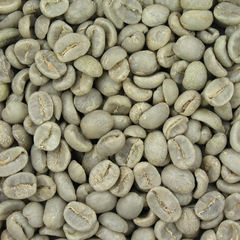
The green beans which have no property of the brown coffee bean, as it is soft and spongy which smells like grass. They are then treated in the big roasters with high temperature; after the required temperature is attained they are suddenly cooled down to save the batch from getting ruined. It takes years of training to learn the art of roasting. In fact many coffee business owners don’t know the exact temperature and process for roasting.

Cooling down the beans help them to keep their aroma and flavor until they are brewed. They are then crunchy and ready to be grinned and brewed.     

Wednesday, September 30, 2015

Evolution of Cherry fruit.

 Hello everyone, this week we are going to talk about Milling the beans, Exporting the beans and Tasting the Coffee.
As in the last week post we talked about how coffee is processed so this week we move on to the final step before exporting the beans overseas. The Milling of the beans step of coffee production is one of the most important part of the coffee process. In this process three types of machinery is used:
  •          Hulling machine:- in this process the external layer of the cherry is removed. It depends on what type of processing is used for the cherry (as discussed in the earlier post dry method or wet method).
  •            Polishing:- this is an optional process as generally this is repetition of the hulling process just to check if any residues are left on the bean. The polished beans are considered as superior quality so being obvious is more expensive.
Green Beans

  •        Grading and Sorting:- This is the final step of milling as in this process the green beans are evaluated on the basis of their size and weight. Not all the beans can be exported as they are rated on a scale of 10-20 according to the size. In addition, the best way to find defective beans is by using the defected machine which sorts the beans on the basis of their shape using a rotatory motion in a drum. However it can also be done by hand picking method.

After all this process, that we have talked so far, now the original cherry fruit is now evolved into green bean.

Fun Fact: Just smelling can wake you up!!

Wednesday, September 16, 2015

Get to know your Coffee


Coffee, the second most popular beverage in the world and first choice of Canadians. In North America 50.8% male and 49.2% of females drink coffee every day. On an average North Americans drink at least two cup of coffee daily. The first cup; as being the obvious to start their day for that energy boost from the caffeine content in it and second one around lunch.

 So the question arise that what do we know about coffee? Not much? Don’t worry our blog is here for the rescue. Let’s start from what does coffee means; it is an Arabic word which means ‘wine of the beans’. Coffee is so valuable that it is the second most traded commodity in this world, only next to petroleum.  

We all have seen those beautiful tiny beans of coffee, they are not as easy as buying a cup of coffee. There is a lot of hard work and efforts of around 20 million people employed in the coffee industry in one way or other.

There are two types of coffee beans

  • Arabica
  • Robusta

Arabica is the most consumed coffee bean (70%) as it is mild and aromatic whereas Robusta (consumed by 30%) is bitter tasting but has around 50% more caffeine content in it.

We all know how to get a coffee but do we all know how coffee is produced? Coffee beans have a long lifecycle which starts from harvesting and ends on roasting (the most important step where the flavour and aroma is provided to the beans).

 Thanks for reading our post this is the first one we will be posting a lot more detailed information so if you would like to know more then do comeback next week.

Fun Fact: It takes five years for a coffee tree to reach full maturity.

What is Bean Belt?

Welcome back to Bean&Machine where you get a lot more to know about coffee last post we introduced you the blog with a little introduction to Arabica and Robusta beans; some stats about the coffee and defining the word coffee itself!
This post will be about what Bean Belt is? And various different parts of world where coffee is grown.
To start with what is Bean Belt? The area between Tropics of Capricorn and Tropics of Cancer on the globe is considered the Bean Belt because of the climate conditions and the special type of soil. In fact a coffee plant to grow properly needs rich soil and a mild temperature, with lots of rain and shaded sun. This is the best place to grow coffee as a good soil; a good climate and a proper altitude affect how the coffee beans will taste.  
  
This is a map displaying the bean belt; where yellow color depicts the bean belt and green color is the countries where coffee is majorly produced.  
Top ten countries according to coffee production:
  1. Brazil
  2. Vietnam
  3. Colombia
  4. Indonesia
  5. Ethiopia
  6. India
  7. Mexico
  8. Guatemala
  9. Peru
  10. Honduras

Now to talk about where did coffee came from, Ethiopia a country which falls under East Africa of African continent. The legends tells that the first coffee tree was discovered here; with a logical explanation as still the wild coffee tree forest are still the primary source of harvested coffee. In addition the first country to commercially cultivate coffee was Yemen (a country in Arabian Peninsula). Unfortunately, in this country the production of coffee is not that big because of unsuitable climate conditions. Specifically less rainfall and arid soil, this results in smaller coffee bean size.   
That’s is all for this week do come back and check our blog for more information on coffee.

Fun Fact: Drinking coffee can increase the metabolism by 3-11%, this chemical plays a vital role in fat burning.